E-Transport Users Unite
Toward an American E-Transport Association

A critical mass of people are now regular users of E-Transport. We need our own organization, our own lobby, and advocacy as a separate interest group.
E-Transport is not just a manual bike. It’s E-Bikes, E-Trikes, cargo bikes, scooters, and exoskeletons. But it’s also delivery vehicles, Electric Rickshaws, and things that are yet to be invented. It’s also E-Motos.
We’re not cars, but we’re not pedestrians, either. We demand safe paths, safe routes, and safe networks. They can be built in concert with sidewalks and roads, but the goal is separation.
I’ve spent most of my life on a manual bike, but I now know the difference electricity brings. Biking is joy, but E-Transport is work. An e-bike is just like a car in that respect. It’s for trips to the doctor, to the store, to school, and to after-school. It’s for the visit to the coffee shop, to the restaurant, to entertainment, and (most important), for the ride back, when you’re tired and happy but you just want to be home.
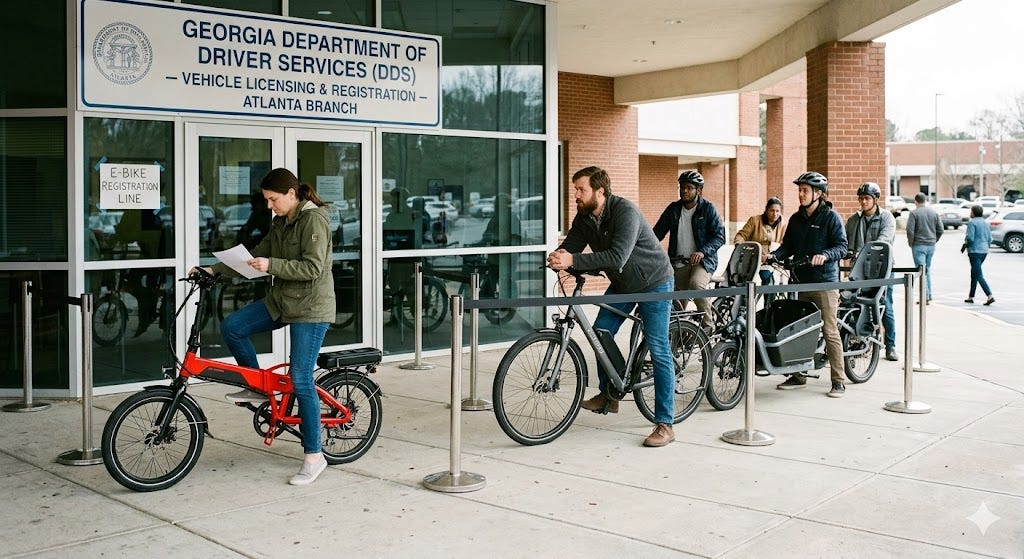
Because we haven’t organized that the Administration could call E-Transport safety “DEI” and take all federal aid away from us, giving it to the owners of F-150s so they can widen stroads and freeways that kill us. Because we haven’t been organized, many states have treated us like criminals and a source of cash, imposing taxes and registration requirements that are unnecessary, giving us nothing in return.
This is bipartisan awfulness.
What E-Transport Stands For
One word. Safety. (Logo by Gemini.)
We don’t just want stripes on roads, or even concrete blocks. We demand paths that are maintained, just as roads are maintained, and that are protected just as roads are. You don’t let trucks stop on the freeway. You shouldn’t let them block the E-Transport path. We also demand right of way on shared city streets, where cars and trucks can go no faster than we can.
Let’s offer something in exchange. Build a financing infrastructure, with voluntary registration through a dedicated organization, offering insurance, and with all the other membership services AAA has provided car drivers for a century. It’s this financial infrastructure that can make political advocacy powerful.
E-Transport advocates can manage arguments between E-Motos and E-Bikes. We can advocate for uniform speed limits, for paths defined for low-speed E-Transport, and for motorcycle-type registration of faster E-Motos. Riders can define the differences, and help bring uniformity to local, state, and federal laws. But only if we’re organized.
E-Transport won’t stand still. It will change and evolve as it grows. We need an organization that can help manage those changes.
Who’s with me?