E-Transport is About Home
Planners Cannot Answer Questions They Do Not Ask

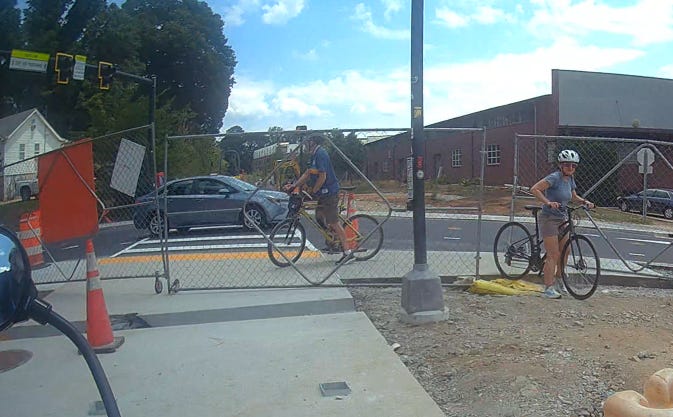
I went food shopping yesterday. (Shown are frustrateed cyclists at an unfinished section of the Atlanta Beltline on May 17.)
It was glorious.
I threw on a backpack, got out the e-bike, and took the long way. The ride took 20 minutes, through a nearby suburb. The ride back took 10 minutes because I bought ice cream.
No need to change clothes, just pull on a helmet and gloves. Less than an hour, there and back, including my time in the store.
It was pure pleasure.
I never did this on my regular bike. It would be 30 minutes getting ready, 20 minutes cooling off, looking silly in my bike shorts and shoes, and you would have heard my clip-ons from the next state over.
On this ride I saw a second e-biker, a younger man filling up his paniers. I suspect he did not own a car. I infer it because he spent 20 minutes arguing over a small discount. It is the kind of time investment you make when you count every dime, when Friday seems a long way away.
This is the real E-Transport Revolution. Short rides, from your home, to shopping, to school, to the doctor. Maybe to work, but probably not. It is an extension of the work from home revolution, which accelerated during COVID, the one our employers have been fighting to put back in the box for no good reason because we are more productive at home, if our job involves information or communicating it. Then there are mothers and the retired, the moms using cargo bikes as the second family car, the retired getting exercise and pleasure while going about the business of living.
Bad Planning
Most E-Transport rides do not occur during the “rush hour,” those hours in the morning and evening when everyone is rushing to and from their jobs. They occur between those times.
What this means is that most E-Transport is invisible to drivers. If you base planning for E-Transport on auto traffic patterns, you wind up with unused bike tracks stealing traffic lanes.
Save money by supporting shared streets. Make cars go at 20 miles per hour, which is a safe speed alongside E-Transport.
I am fortunate. My neighborhood existed before World War II. There are multiple ways to get around, from here to there. I do not have to travel four miles on a 5-7 lane stroad to visit the neighbor behind my fence. My coffee shop is not at the back of a huge parking lot, at a crowded intersection of two five lane roads. It sits by the street, near houses.
This is where planners need to get to work. Supporting the short E-Transport trips that make life worth living is the unmet challenge. No one is addressing it, because no one involved in planning knows where the E-Transport Revolution is even happening, or what it will take to support it.
Anything within five miles of you can be 30 minutes of pleasure away. How do we make that safe for people on two wheels, at 15 miles per hour? Those are the questions we need to answer.
No one is even asking them.