NOTE: If you like OpaFiets, please Restack it and pass it around. You’re not its customer. You’re its reader.
I was e-biking home from the chiropractor the other day when I decided to take a bike path.
It nearly got me killed.
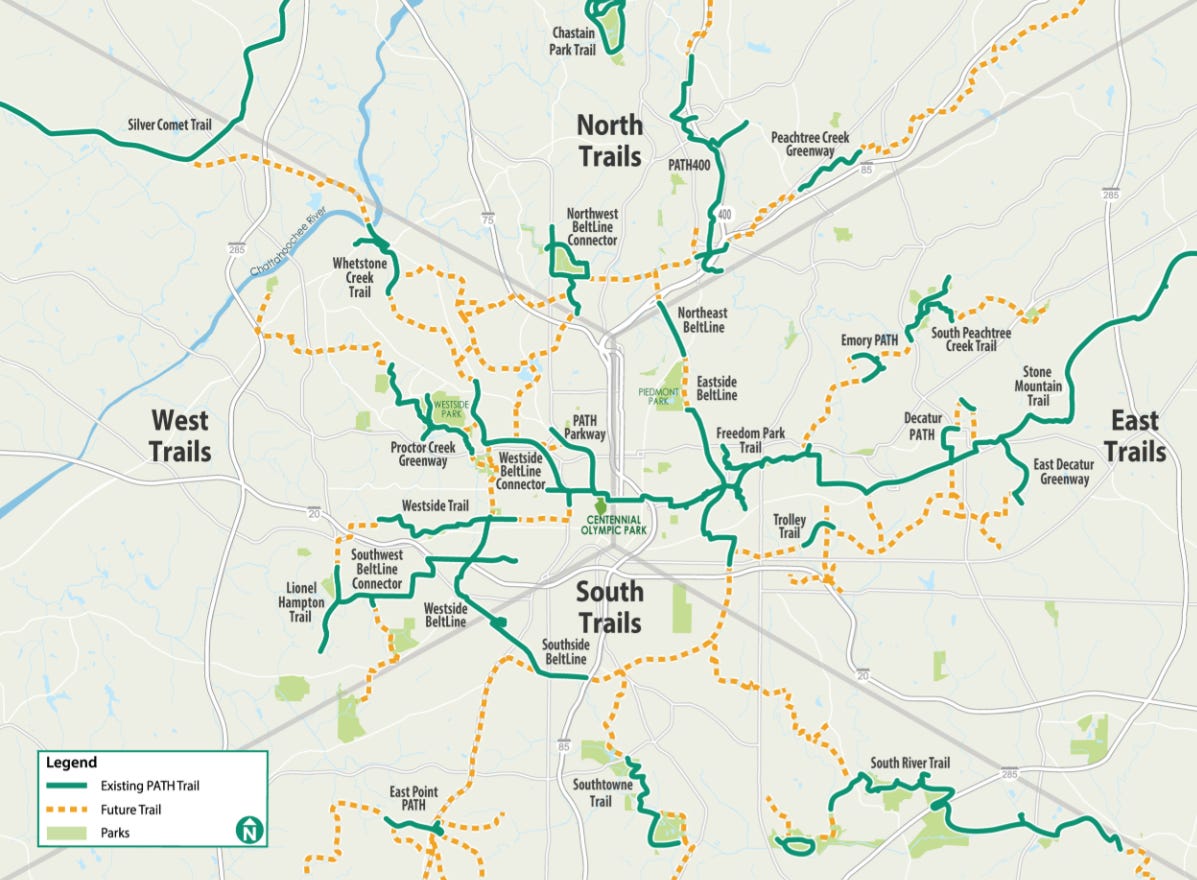
The path runs around a new park, next to a two-lane road cars frequently drive at 50 mph. I usually use that road with no problem. Cars see me and there are turn lanes I can use to get out of their way. The path is called the East Decatur Greenway and was built by PATH, which says it exists to promote “trail development.” Their mission page is filled with bikes of all kinds, but none with motors.
Heading south, a bike can’t easily get on this trail. The graded entrance is two blocks from the road leading to it. I learned that a few weeks ago. Some enterprising cyclists have scratched out an entrance through grass, about 40 feet from the trail’s intersection with a main road going south. You have to stop, and you may have to get off the bike to be safe.
I used it.
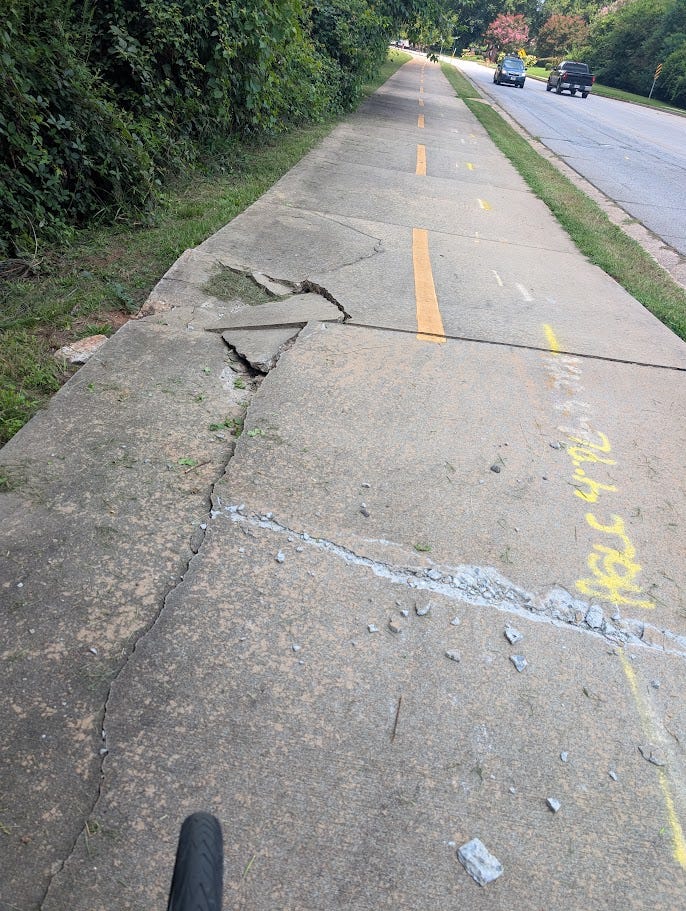
Any bike freewheeling downhill, electric or not, will reach speeds of 20-30 miles per hour, depending on the slope of the hill. I was doing 20 when I hit the patch pictured below, which doesn’t do it justice. Something has pushed the pavement here up about 2 feet, and there’s no warning, no way around it. I stopped pedaling, tried to brake, but flew up in the air like a 12-year-old on a banana seat anyway.
This is no fun when you’re 71. But the jump also caused my chain to fall off the crank. I had to spend several minutes at the side of the trail putting it back.
Trails Aren’t Bike Paths
The bottom line is that I would have reached home safer, and much faster, had I used the road.
PATH trails aren’t built for bikes, despite the nice pictures. They’re built for people who are walking their dogs or taking the kids out to play. Those aims are legitimate, they’re fine, but they’re not E-Transport. They’re not even bike paths.
They’re shared paths, and there’s a big difference. A shared path is primarily for pedestrians. They have right of way. Pedestrians may travel at 3 mph. Or they may stop, turn around, walk off the trail, and (if they’re kids) run off to look at bugs. This is fine, it’s admirable.
But that’s not what bikes are for, and it’s not what E-Transport is about.
Bikes want to go far. They’re fun. They’re exercise. Hop on, get in your workout, and hop off. More likely get into spandex, strap on your clip-ons, pull on your gloves, double check your helmet straps and mirrors, then hop on. They can be recreation vehicles rolling at 10-15 mph through the countryside, sometimes with someone’s entire lifestyle strapped on with bungee cords.
E-Transport often runs at a similar speed. Its purpose may be commuting, shopping, going to appointments, schools, whatever. It’s literally hop on, get to where you’re going, and lock up. You don’t need special pants, gloves, nor shoes, and if you’re riding an upright Dutch style bike, going at under 10 mph, you don’t really need a helmet.
The destination is the point of E-Transport. It’s the thing you want to do at the end of the ride. You want to work, you want to learn, you want to have a drink or a meal with friends.
PATH Doesn’t Get It
PATH doesn’t recognize these differences. They don’t view E-Transport, the very thing that is driving their success, as legitimate.
I’ve said this before. It’s the purpose of my OpaFiets Substack. E-Transport needs its own bike paths, and it needs advocacy, separate from the interests of recreational cyclists and pedestrians. Most of our travel, for the foreseeable future, will be on roads, the same roads cars use. Those roads need to be made safe, which will also make them safer for car drivers.
There are risks to E-Transport. People will go faster using E-Transport than they would while walking or on a joy ride. We need our own organization to mitigate those risks, and to minimize them.
We don’t travel the same path, and we don’t need the same PATH. As I found this week, that PATH will get some of us killed.